
Business Management Consulting Company UAE, Oman, Qatar > Strategy Management Software > The GCC’s AI push is here. Is your data ready?
The GCC’s AI push is here. Is your data ready?

Across the Gulf, the question is no longer whether to adopt artificial intelligence. That has been settled at national level, with funding, mandates and timelines attached. The open question is narrower, and it sits inside each organisation: when an AI reads your performance data, what is it actually going to find?
The commitment is already made
The direction of travel is clear and well documented. At federal level, the UAE has launched its Agentic AI Project, aiming to transform half of federal government sectors, services and operations into autonomous, AI-driven models within two years. In June 2026 the UAE approved the establishment of the Artificial Intelligence and Data Authority, with a mandate that covers leading the national AI strategy, managing government data to improve its quality and availability, and enabling data sharing across entities.
Saudi Arabia made the same point earlier, and named it. The Kingdom’s strategy, launched by SDAIA, is the National Strategy for Data and AI. Data comes first in the title, and the National Data Management Office was created alongside it to own data management, policy and compliance.
That ordering is worth sitting with. The institutions driving the region’s AI agenda have placed data governance at the centre of it from the beginning. The strategy is not the gap. The gap, where it exists, is organisational.
Appetite is not the constraint either
Regional leadership shows up in the boardroom as well as the ministry. PwC’s 29th Global CEO Survey: Middle East findings, drawn from more than 300 chief executives across the region, found that 82 per cent say their organisation’s culture enables AI adoption, and 70 per cent now have a clearly defined roadmap for AI initiatives. Across every area measured, Middle East CEOs report applying AI more widely than the global average.
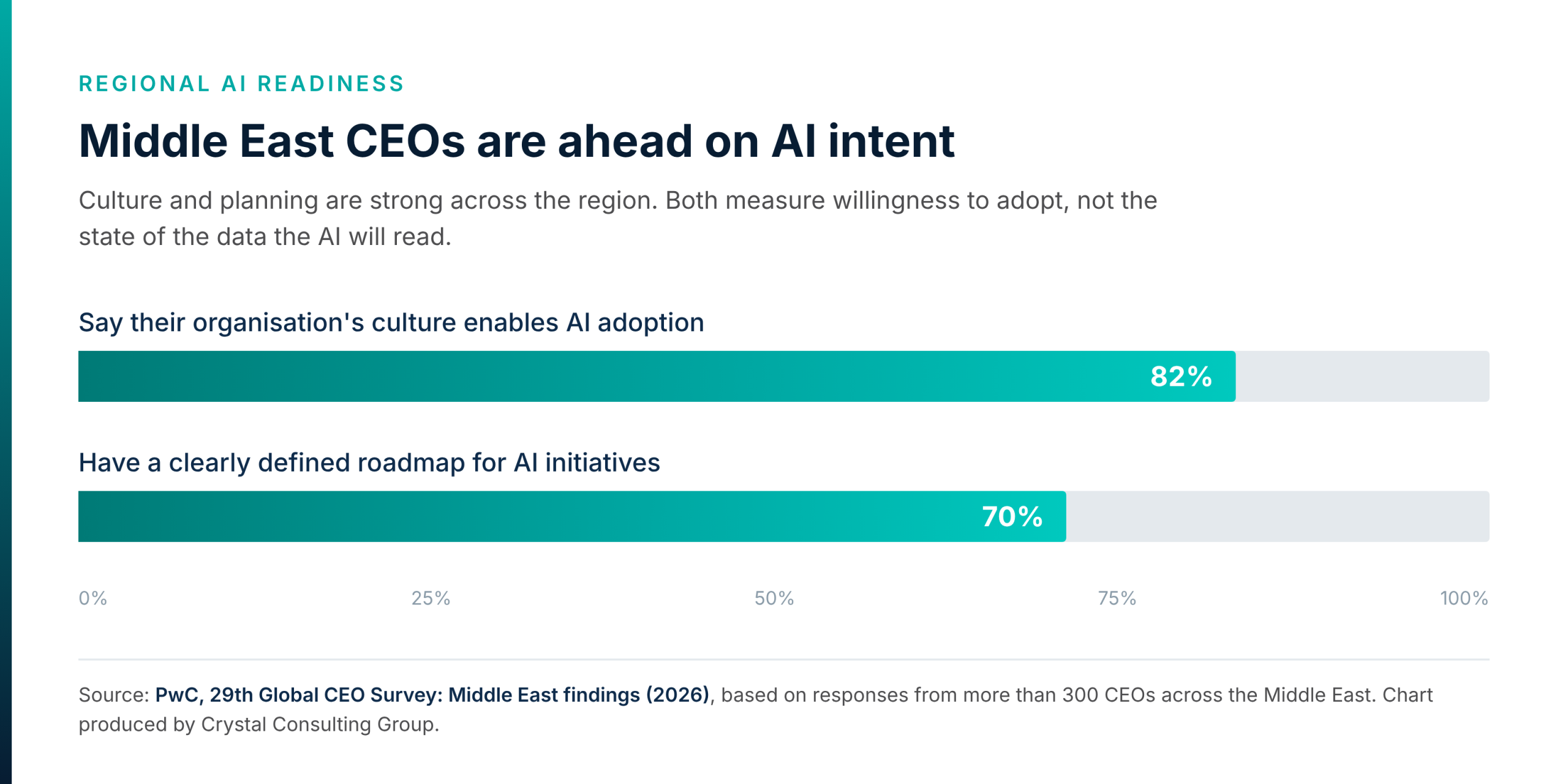
Both of those figures measure intent. Neither measures the condition of the data an AI will be asked to read. That is the variable nobody surveys, and it is the one that decides what you get back.
Three things AI will not fix for you
In performance management work across the Gulf, the same three gaps appear long before AI enters the conversation. Each one quietly degrades anything built on top of it.
→ A KPI that nobody owns. An AI can tell you a measure is red and falling. It cannot tell you who is accountable for moving it, and it will not notice that the answer is nobody.
→ A metric that means different things in different entities. One name, four definitions, four versions of the truth. An AI reading all four will roll them up without flagging that they were never comparable.
→ A number with nothing behind it. Where there is no comment or evidence trail, there is no way to check why a value moved. Interpretation then rests on a figure nobody can explain.
None of these are new problems, and none of them are AI problems. They are the reason we keep returning to fundamentals in work like Understanding KPIs: The Basics and why moving off spreadsheet-based reporting matters more than any single feature. What is new is the cost of leaving them unresolved. A flawed scorecard used to produce a confusing report. A flawed scorecard read by AI produces a confident, fluent, well-structured wrong answer, and it produces it faster than anyone can check it.
What a well-built system actually does
The design principle that matters here is simple, and it is worth asking any vendor to demonstrate: the platform should calculate, and the AI should only interpret.
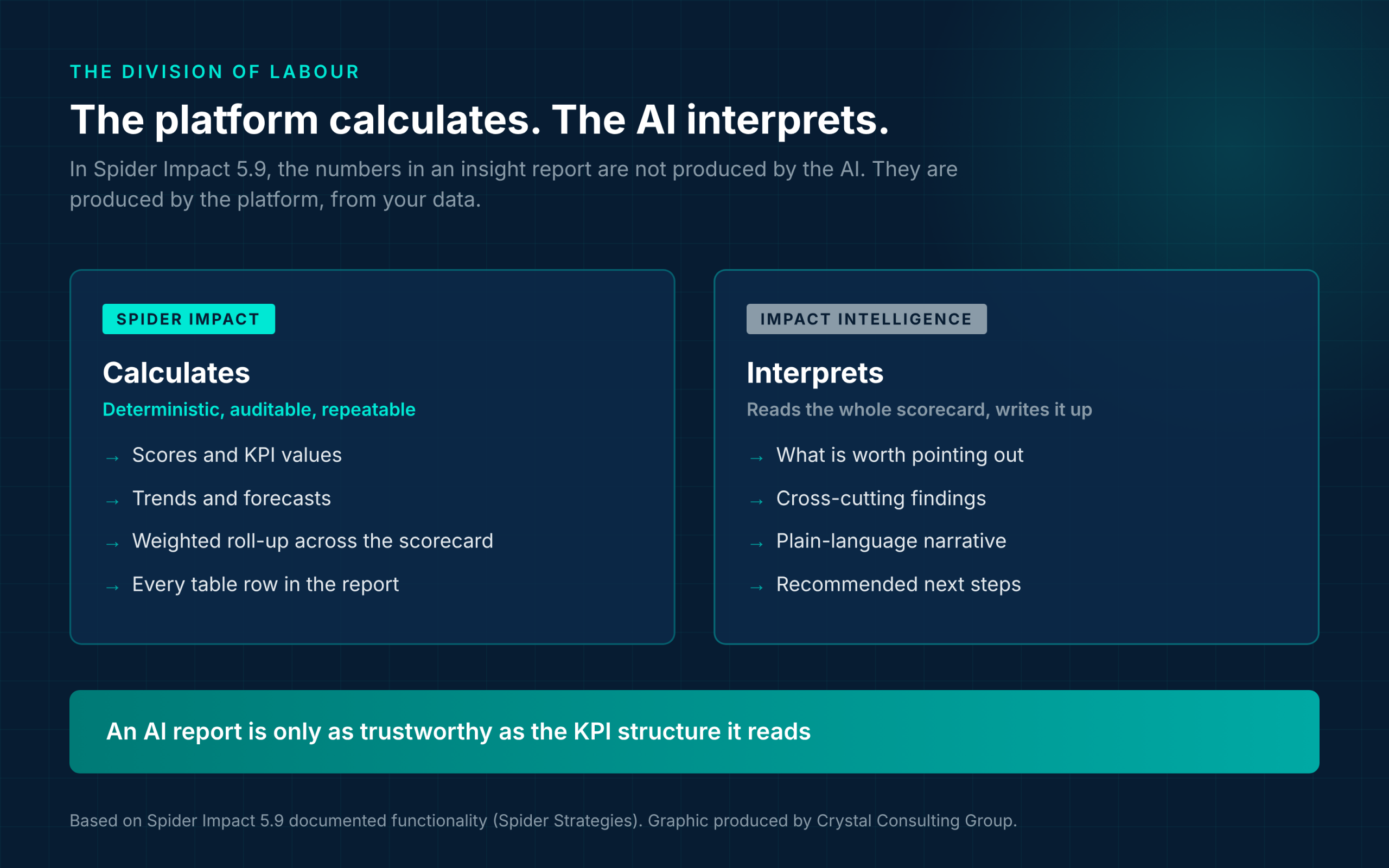
Spider Impact 5.9 is a useful illustration. Its new Scorecard Insights tab reviews an entire scorecard, every KPI, goal, trend, forecast and attached initiative, and writes a strategy audit in plain language. Every number in that audit comes from Spider Impact’s own calculations. The platform computes the scores, values, trends, forecasts and table rows; the AI decides what is worth pointing out and writes about it. Every item the report names links straight back to the item itself.
One section goes further. Corrective Actions is not written by the AI at all. It is built directly from your data, listing red KPIs with no initiative behind them, and initiatives that do not appear to be helping what they are attached to. Each of those is a gap in the plan, surfaced without interpretation. That is only possible because the underlying structure is sound. The feature is downstream of the discipline.
Governance belongs in the same conversation
For banking, government and other regulated environments, the first question is rarely what the AI can do. It is what the AI can see.
In Spider Impact 5.9, every dataset carries a setting controlling whether Impact Assistant may use it. Uncheck it and the assistant stops using that dataset immediately, even mid-conversation. An excluded dataset is not described to the AI service at all. Test copies, training data and near-duplicates sitting alongside live records stop being a risk the moment someone decides which of them counts.
This sits alongside the deployment question we cover in Strategy Execution: Fit, Not Force. Organisations with security, compliance or data sovereignty requirements have real choices to make about where their performance data lives, and those choices should be made before an AI layer is switched on, not after.
Five questions worth answering first
None of the following are technology questions. All of them determine whether an AI reading your scorecard produces insight or confident noise.
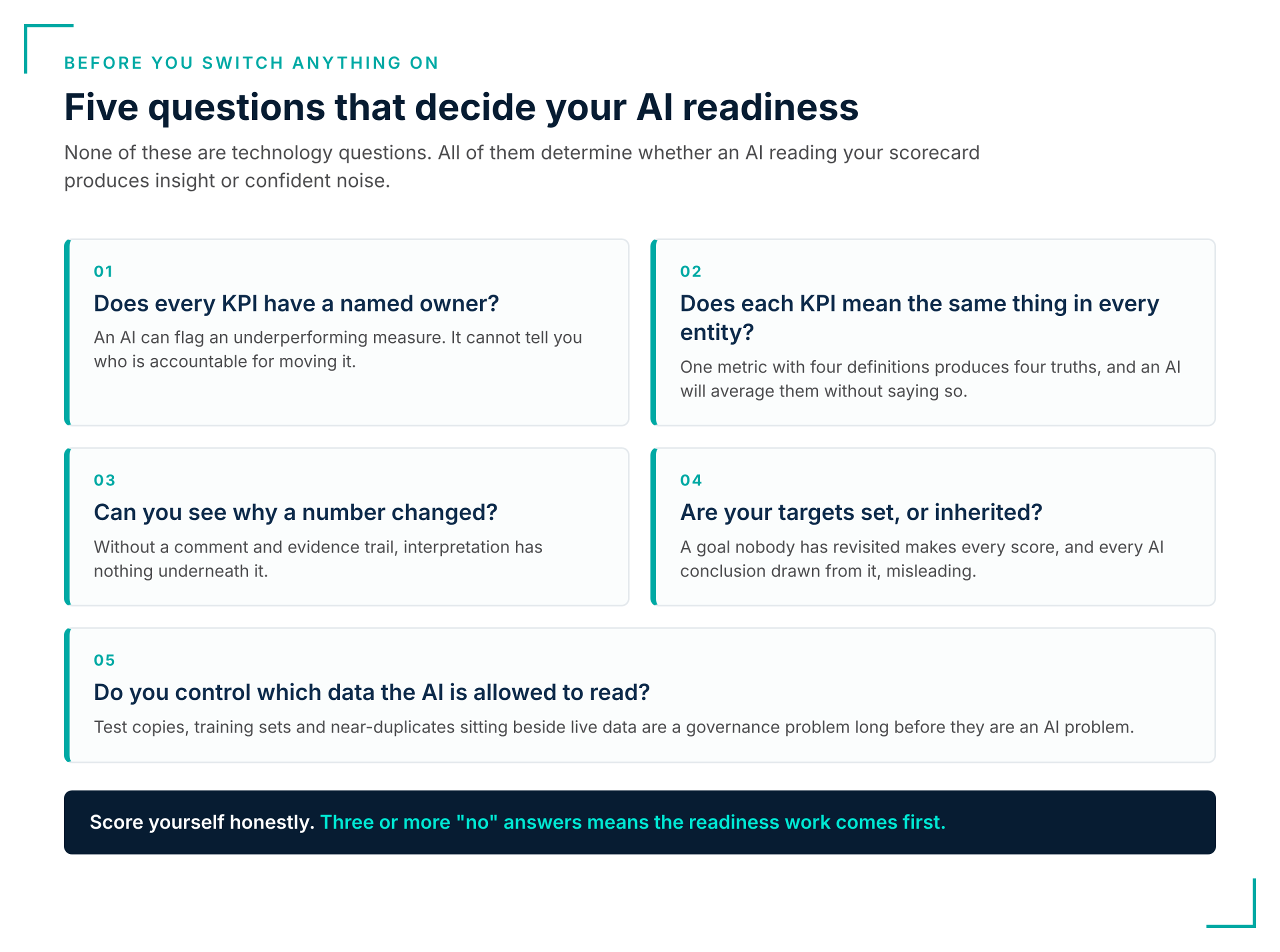
If three or more answers are uncomfortable, the readiness work comes first. That is not a reason to slow down on AI. It is the fastest available route to getting value from it, and it is work that pays off whether or not an AI ever reads the result. The same structure that makes AI output trustworthy is what makes a balanced scorecard work in the first place.
Where Crystal Consulting Group fits
Crystal Consulting Group is the only reseller of Spider Impact in the Gulf region and an authorised partner of Spider Strategies, working with organisations across the UAE, Saudi Arabia, Qatar, Oman and Pakistan. Our work starts where the readiness questions above start: KPI definition, ownership, cascading structure and the evidence trail underneath. The platform comes after that, not before it.
The region has built the opportunity. The question each organisation now has to answer for itself is a smaller one, and a harder one.
If an AI read your scorecard tomorrow morning, would you trust what it told you?
Sources
PwC, 29th Global CEO Survey: Middle East findings (2026)
UAE Artificial Intelligence Office, National Strategy for Artificial Intelligence 2031
UAE Government portal, National Strategy for Artificial Intelligence 2031 (full document)
Saudi Data and Artificial Intelligence Authority (SDAIA), National Strategy for Data and AI
Spider Impact 5.9 functionality described from Spider Strategies 5.9.0 beta release documentation.
Crystal Consulting Group | crystalconsultinggroup.com | sales@crystalconsultinggroup.com
UAE +971 50 526 1369 | KSA +966 54 165 1531
Tags
#Automation
#BalancedScorecard
#BusinessIntelligence
#BusinessSoftware
#BusinessStrategy
#Customization
#DataVisualization
#DecisionMaking
#GoalAlignment
#GoalSetting
#GoalTracking
#InitiativesManagement
#KPI
#KPIManagement
#PerformanceImprovement
#PerformanceManagement
#PerformanceTracking
#ProjectManagement
#Reporting
#SMARTGoals
#SoftwareSelection
#SpiderImpact
#StrategyExecution
#StrategyManagement
#StrategyMaps
#StrategySoftware
#Visualization
#نمو_الأعمال