

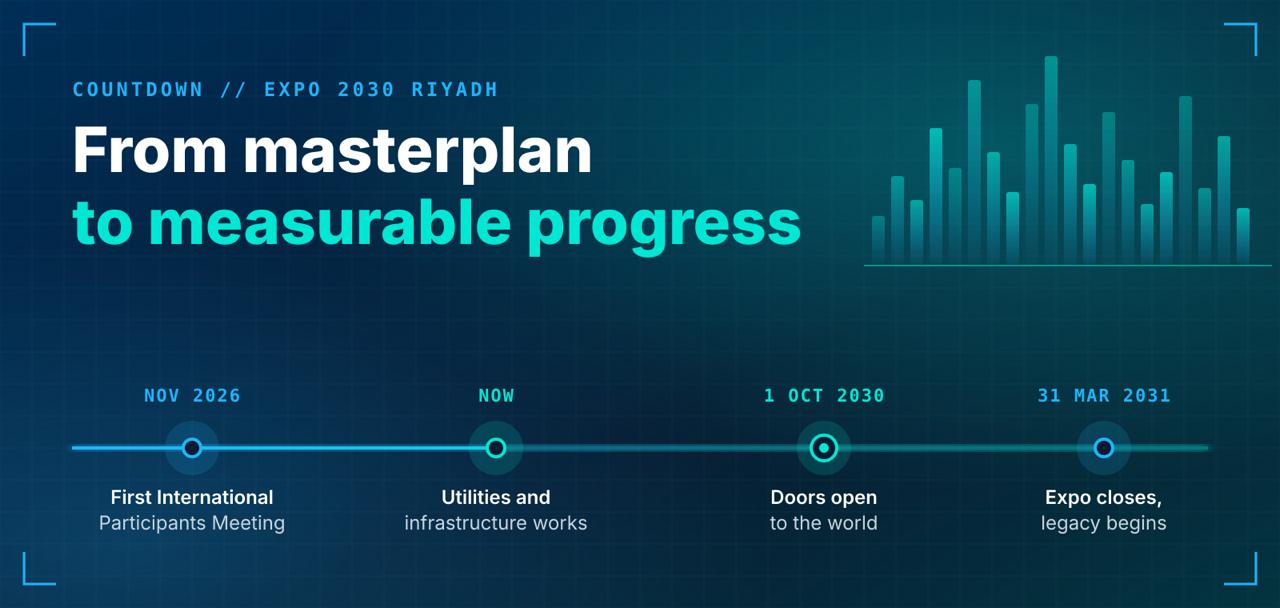






On 1 October 2030, Expo 2030 Riyadh opens its doors, and for six months, until 31 March 2031, the world comes to the Saudi capital. Every venue, road, hotel room, service and system connected to it needs to be ready on the day, not the week after.
The work is well under way. For the many organisations whose own plans now lead to that date, the most useful question isn’t “are we committed?” It’s “can we show exactly where we stand today?”
It’s a programme built to last, which is exactly why the work behind it needs to be measurable from the start.
Behind any event of this scale sit hundreds of organisations, each running a programme of its own: government entities, developers, contractors, hospitality groups, transport operators and suppliers. Each has its own goals, budgets and milestones, and each plays a part in the wider story of Saudi Vision 2030.
We explored this in Three Visions Worth Getting Right: national ambition becomes reality at the organisational level. A fixed opening date makes that even more true. When the date can’t move, the variable that matters most is how early you see what needs attention.
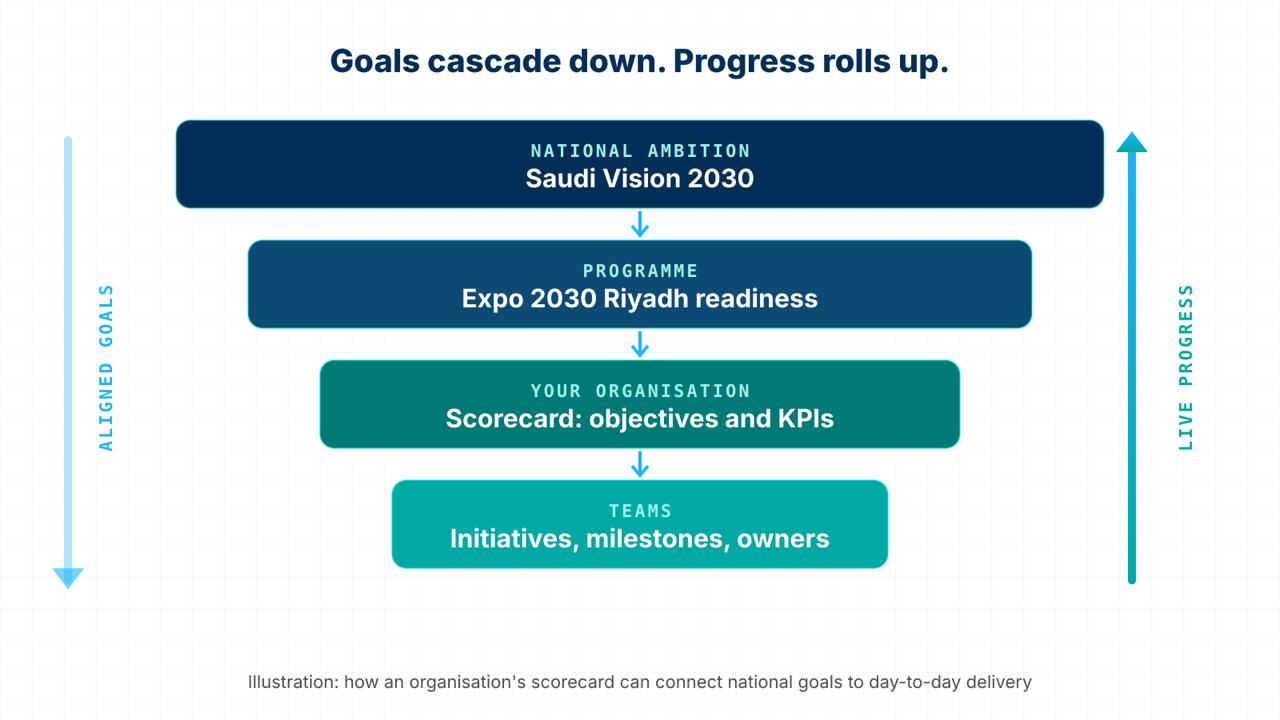
Everyone should be able to see how their work connects to the bigger objective. In Spider Impact, cascading scorecards link organisation-wide objectives to the department KPIs and initiatives that deliver them. A delay in one team shows up in context, rather than sitting unnoticed in a spreadsheet. It’s the same alignment challenge we covered in Cross-functional Alignment: Why Strategy Stalls Between Departments.
On a long programme, the costliest problem is the one spotted too late. Spider Impact uses Earned Value Management to predict whether an initiative will finish on time and within budget, and shows whether it is actually moving the KPIs it was meant to improve. We looked at the real cost of late discovery in What Is a Delayed Red Flag Really Costing You?
With so many stakeholders, review meetings multiply fast. Spider Impact Briefings work like a presentation whose slides are live: they always show the latest data and can be tailored for board, executive and department reviews. Less time rebuilding slide decks means more time making decisions, as we explained in Why Performance Reviews Take Longer Than They Should.
When many parties report into one programme, trust in the numbers matters. Spider Impact 5.9 introduces multi-level KPI approval with up to four sign-off levels, so a value can pass through a section head, a director and the strategy office before it becomes official. Every approval and rejection is recorded in a full audit trail.
The same release adds Scorecard Insights, which reviews an entire scorecard and writes a plain-language strategy audit. Every number in it comes from Spider Impact’s own calculations, not the AI. Read the full rundown in Spider Impact 5.9 Is Here.
Expo 2030 Riyadh is a once-in-a-generation moment for the Kingdom. The organisations that contribute most will be the ones that can see their progress clearly, act early and report with confidence, every month between now and opening day.
Crystal Consulting Group is a VIP partner of Spider Strategies and the only Spider Impact reseller in the Gulf. Through Crystal Guru Management Company, our team in Saudi Arabia helps organisations design their scorecards, set up initiative tracking and move their progress reviews onto live data.
If your programme had to report its readiness tomorrow, how confident would you be in the numbers?
Talk to our team
📧 sales@crystalconsultinggroup.com
🌐 crystalconsultinggroup.com
📞 UAE: +971 50 526 1369 | KSA: +966 54 165 1531
Give us a call or drop by anytime, we endeavour to answer all enquiries within 24 hours on business days.
Your success is our priority. Let us know how we can support you.
نجاحك هو أولويتنا. أخبرنا كيف يمكننا دعمك.
Your success is our priority. Let us know how we can support you.
Your success is our priority. Let us know how we can support you.
Your success is our priority. Let us know how we can support you.
Your success is our priority. Let us know how we can support you.
Your success is our priority. Let us know how we can support you.
Your success is our priority. Let us know how we can support you.