

Introduction
Picture yourself approving critical budget requests during a flight delay, monitoring project milestones from a client site, or keeping essential workflows moving while traveling—all from your smartphone. Mobile BPM transforms these scenarios from wishful thinking into everyday reality for forward-thinking organizations.
Today’s distributed workforce demands location-independent productivity. Desktop-bound approval processes create bottlenecks whenever key stakeholders step away from their desks. Communication delays compound these problems, slowing decisions that could otherwise move at the speed of business. Your team can’t afford to wait for someone to return to their office to keep operations moving.
This article reveals how mobile workflow automation, offline access capabilities, and integrated Business Process Management tools transform your organization’s productivity. You’ll discover practical strategies for implementing mobile solutions that keep your business processes moving—regardless of where your team works.
Main Takeaways
- Location-Free Operations: Mobile BPM transforms smartphones into business command centers, liberating teams from desktop constraints and enabling productivity anywhere
- Uninterrupted Workflows: Offline capabilities maintain critical processes during connectivity gaps, preventing costly delays and preserving business momentum
- Rapid Decision Cycles: Mobile notifications and streamlined approvals eliminate workflow bottlenecks, accelerating decisions across distributed teams
- Seamless Team Coordination: Integrated platforms merge communication with process management, enabling real-time collaboration for remote workforces
Mobile Workflow Automation for Remote Collaboration
When your team spans multiple time zones and urgent decisions need approval from stakeholders across three different countries, traditional coordination methods create dangerous bottlenecks that can paralyze entire projects. Mobile BPM solutions eliminate these geographic barriers by enabling seamless remote collaboration that keeps critical business processes flowing regardless of team location.
Real-time task assignment and status updates form the backbone of effective mobile collaboration. You can instantly assign tasks to team members anywhere in the world, with automatic notifications ensuring immediate awareness. As projects progress, team members update status, add comments, and submit deliverables directly from their smartphones. This creates continuous information flow that keeps everyone aligned without email delays or coordination confusion.
Digital approval processes remove location-based decision bottlenecks by enabling stakeholders to review and approve documents from mobile devices. Whether it’s budget requests during a commute, project milestones between meetings, or critical documents while traveling, mobility transforms approval cycles from multi-day waits into same-day resolutions. You’ll accelerate business velocity while eliminating the frustration of urgent decisions waiting for someone to return to their desk. Research shows that AI assistance enables agents to resolve 14 percent more service chats per hour, and similar productivity gains extend to mobile workflow processes.
Beyond simple approvals, communication platform integration creates unified collaboration environments where workflows and conversations happen in the same digital space. When team members need clarification or coordination, they can initiate discussions directly within the mobile workflow platform. This ensures all relevant context remains connected to the specific process and prevents information silos that develop when teams juggle separate tools for communication and process management. The impact proves measurable: 64% of surveyed workers indicated that access to AI and GenAI tools will boost their productivity, particularly when these technologies integrate into collaborative workflows.
These capabilities fundamentally transform how distributed teams operate. You’ll create responsive organizations where geographic distance no longer determines business process speed. The transition from person-dependent coordination to structured workflows enables competitive advantage through faster decision-making, improved collaboration quality, and enhanced productivity. With productivity growth declining rather than improving despite technological advances, strategic implementation of mobile workflow automation becomes critical for maintaining competitive advantage in today’s distributed work environment.
Ready to eliminate workflow bottlenecks? The next section explores how offline access ensures your mobile processes continue running even when connectivity doesn’t cooperate.
Offline Access and Business Continuity
Network outages strike without warning. Your team needs to process critical approvals, but the WiFi just died. Traditional systems leave you stranded, but mobile BPM platforms with robust offline capabilities keep your operations running smoothly.
Mobile BPM solutions function as independent workflow hubs during connectivity disruptions. These platforms store essential process data locally on each device, maintaining full functionality for forms, approvals, and task updates. You can continue working on inspections, customer requests, or financial approvals exactly as if you were connected to the network.
Think of it like having a complete office backup that fits in your pocket. When the power goes out in your building, you don’t lose the ability to make decisions or complete critical tasks. Offline mobile BPM works the same way for your digital processes.
Advanced bi-directional synchronization transforms offline work from emergency mode into seamless operations. Once connectivity returns, the system automatically pushes all offline activities to central servers while maintaining perfect data integrity and complete audit trails. Your work never disappears during connectivity gaps, and team members receive updates the moment network access resumes.
Emergency workflow access proves invaluable during planned maintenance windows and unexpected disasters. You maintain operational efficiency during system upgrades, ensuring critical processes never pause due to technical issues. Healthcare facilities continue managing patient care during system maintenance. Manufacturing plants handle safety inspections in connectivity dead zones. Emergency response teams coordinate effectively in disaster areas where cellular towers may be compromised.
The business impact extends far beyond temporary inconvenience. A 230-year-old manufacturing leader struggling with inefficient ticket routing discovered that improving operational systems could generate millions in annual savings when implemented across facilities. Plus, research from the World Bank shows how increasing use of smartphones and tablets makes offline functionality increasingly critical as organizations rely more heavily on mobile workflows.
Industries where offline access becomes essential include sectors that can’t afford connectivity-based shutdowns. Healthcare facilities manage patient care during system maintenance. Manufacturing plants operate in connectivity dead zones on production floors. Transportation and logistics operations serve remote areas. Field service teams work in underground or rural locations. Emergency response teams coordinate in disaster zones where infrastructure fails.
Smart business continuity planning incorporates offline functionality as standard operational practice rather than emergency backup. This approach creates competitive advantage through consistent service delivery that never depends on perfect connectivity. You deliver reliable customer service while competitors struggle with “system down” messages.
Ready to explore the platform features that maximize your mobile BPM investment? Let’s examine the tools and capabilities that transform mobile workflow technology into measurable organizational results.
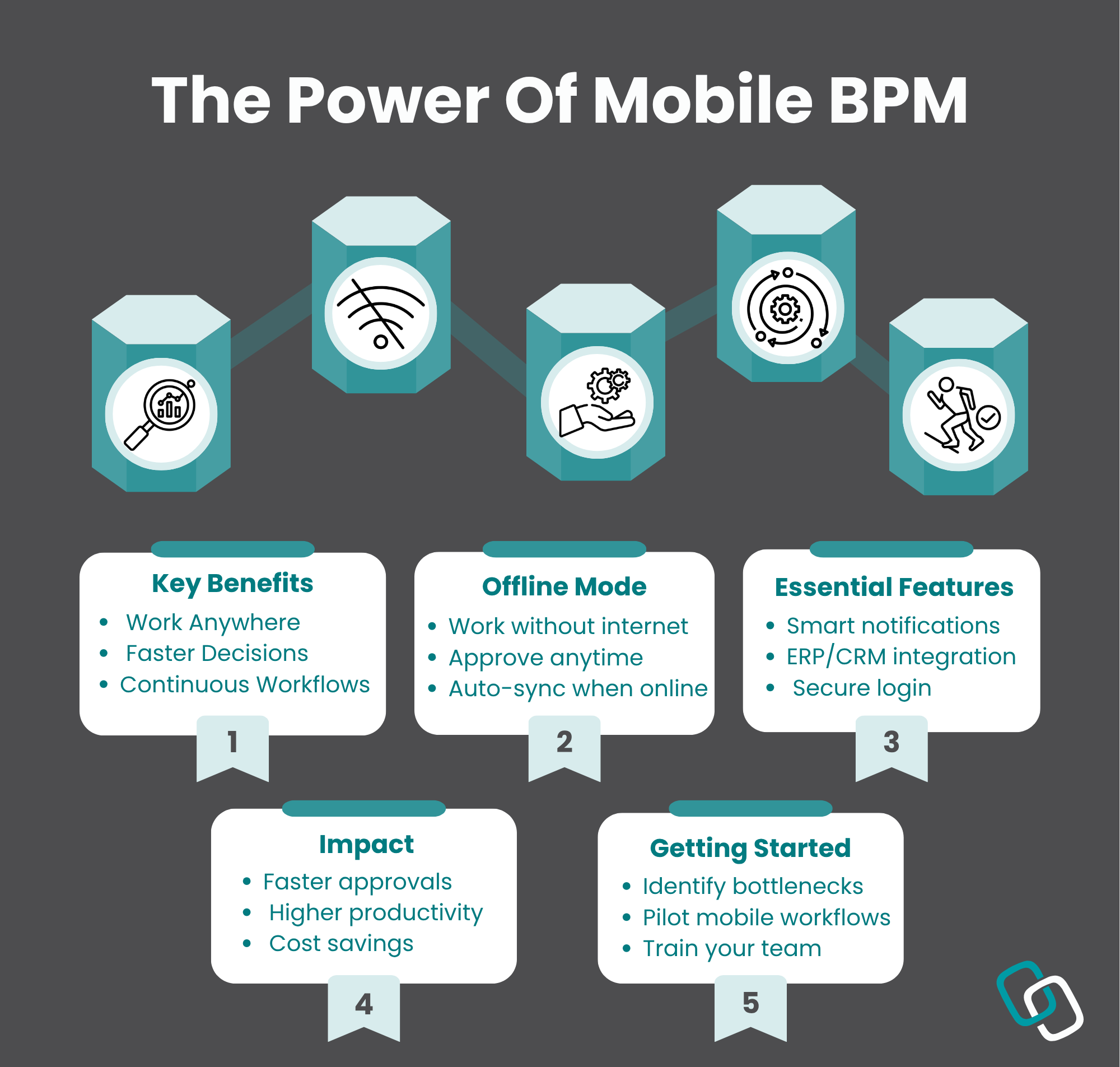
Mobile BPM and Business Process Management Tools
Choosing the right mobile BPM platform determines whether you’ll transform productivity or simply digitize existing inefficiencies. The difference comes down to selecting features that solve actual business problems rather than impressive-sounding capabilities that gather dust after implementation.
Organizations consistently report that platforms chosen primarily for feature lists rather than practical application fail to deliver expected productivity gains. The key lies in understanding which capabilities drive business results versus those that simply look impressive in sales presentations. Focus on capabilities that directly address your workflow bottlenecks and user experience needs when evaluating platforms.
Essential Platform Capabilities
Your mobile BPM solution must deliver complete functionality, not simplified versions that force users back to desktop systems for complex operations. The most effective platforms handle comprehensive task management, approval routing, and process monitoring with the same sophistication available on traditional systems.
Low-code platforms accelerate technology life cycles, allowing organizations to do more with less, faster. These platforms enable teams to build production-ready tools in days rather than months, ensuring workflow solutions reflect operational reality rather than theoretical ideals.
Effective push notification systems deliver contextual information that enables immediate decision-making. The most powerful platforms include relevant process details, attachments, and approval history within notifications, allowing users to take action without launching multiple applications to gather context.
Robust offline functionality ensures business continuity when connectivity becomes unreliable. Enterprise-grade solutions store critical data locally and synchronize automatically when connections restore, preventing the workflow interruptions that plague many organizations during network outages or system maintenance.
Integration and System Connectivity
Mobile BPM platforms generate exponential value through seamless integration with existing business systems. You’ll want to prioritize solutions offering pre-built connectors to popular ERP, CRM, and document management platforms, plus flexible API capabilities for custom integrations.
Modern applications optimize internal cooperation through enhanced collaboration possibilities. Field staff can record maintenance or service data at customer sites and transfer it in real time, while viewing and changing order data and delivery information. This ensures conversations about performance happen in context rather than in separate email chains that become impossible to find months later.
Authentication integration with your current security infrastructure maintains consistent access controls across all platforms. Single sign-on capabilities reduce password complexity while ensuring enterprise-grade protection for sensitive process data accessed through mobile devices.
Deployment Considerations
Your choice between cloud-based and on-premise solutions depends on security requirements, compliance obligations, and technical infrastructure preferences. Cloud-based solutions typically provide faster deployment, automatic updates, and superior scalability compared to on-premise alternatives. However, organizations with strict data sovereignty requirements may prefer on-premise platforms that maintain complete control over data storage and processing locations.
Cloud platforms excel in agility and cost-effectiveness, while on-premise solutions offer maximum customization and control. Research shows that intelligent automation implementations deliver significant value, with organizations achieving 330% ROI over three years through comprehensive process automation strategies. Meanwhile, companies investing heavily in automation achieve 22% cost savings compared to just 8% for organizations with minimal automation investment.
These platform capabilities provide the foundation for transforming your mobile BPM investment into measurable organizational improvements and sustainable productivity gains across your entire operation.
Unleash Your Organization’s Mobile Potential
Success with Mobile BPM depends on execution, not just recognition of its benefits. Your implementation strategy determines whether you’ll transform productivity or simply digitize existing inefficiencies.
Start by identifying workflows that create bottlenecks when location constraints prevent immediate action. Target approval chains, customer service responses, and field data collection first. Pilot programs prove valuable here—they let you test mobile capabilities on select processes before committing to organization-wide deployment.
Change management becomes your foundation for successful adoption. Most employees embrace mobile solutions because they already navigate smartphones intuitively. Focus training on demonstrating how mobile access eliminates daily frustrations rather than adding complexity. When people see clear time savings and immediate productivity improvements, enthusiasm builds naturally.
Establish specific measurement criteria for tracking ROI, including approval cycle times, process completion rates, and employee satisfaction scores. Most implementations show measurable improvements within the first quarter.
Your transformation starts with evaluating current process bottlenecks. Consider which workflows suffer most from location constraints, then prioritize these for mobile enablement. Mobile BPM solutions unlock productivity on the go—they unleash your team’s potential to work effectively from anywhere.