
Introduction
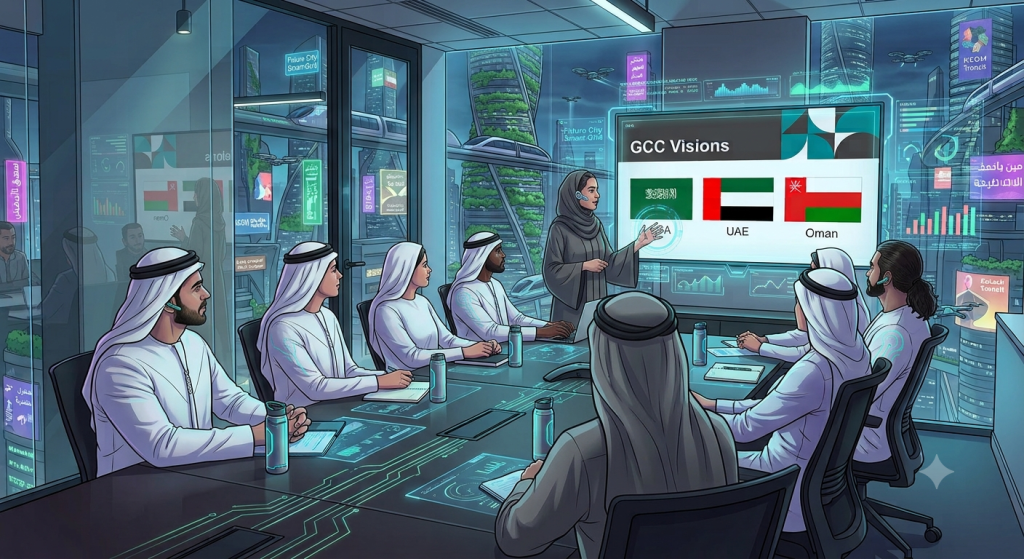
The Gulf region sits at the center of three of the world’s most ambitious national transformation blueprints. Saudi Vision 2030, We the UAE 2031, and Oman Vision 2040 each represent a generational commitment to economic diversification, human development, and long-term prosperity — promises that will shape the region for decades.
But national ambition only becomes reality at the organizational level. For leaders across the Gulf, the question isn’t whether these visions matter. It’s what your organization must actually do to play a meaningful part in delivering them.
Vision without execution is aspiration. Turning national intent into measurable progress demands structure, accountability, and the right frameworks. That’s exactly what this article explores.
Main Takeaways
- Execution Over Aspiration: All three Gulf visions succeed only when the organizations beneath them deliver measurable results — ambition without accountability stays a declaration.
- Frameworks as the Engine: KPIs and strategic frameworks aren’t bureaucratic overhead — they’re what converts national intent into organizational action.
- Purpose-Built Tools: The Balanced Scorecard, OKRs, and Spider Impact bridge high-level strategy and ground-level execution by making contribution visible and trackable.
- Regional Expertise: CCG brings the consulting depth and implementation experience to make these frameworks work across the Gulf.
Three Gulf Visions Driving National Transformation
Saudi Vision 2030 sets out a comprehensive national transformation agenda centered on economic diversification, human development, and expanding the Kingdom’s global standing. We the UAE 2031 positions the UAE among the world’s most competitive and innovative economies, with targets spanning quality of life, economic output, and human capital. Oman Vision 2040 commits to building a diversified, knowledge-based economy rooted in Omani identity and sustainable development.
What unites all three isn’t just ambition — it’s architecture. Each vision establishes long-term national targets designed to cascade downward: from ministries and sectors to individual entities and organizations. These aren’t aspirational declarations. They’re delivery frameworks built to be executed at every level of the economy.
That cascade creates a shared challenge. When ambition flows top-down but accountability doesn’t flow back up, organizations can find themselves aligned in spirit but invisible in impact — genuinely committed to the vision, yet unable to show what their contribution actually looks like in practice. That gap is exactly what the next section examines.
The Strategy Execution Gap Organizations Must Close
Most organizations operating in the Gulf would say they support their national vision. They reference it in strategy documents, mention it in leadership communications, and genuinely believe their work contributes to the broader transformation agenda. But genuine belief and measurable contribution are different things — and the distance between them is where execution quietly fails.
That distance has a name: the strategy execution gap. It describes the translation problem between national-level ambition and what actually happens at the organizational level on any given day. Without structured frameworks, your organization may feel aligned — teams working hard, initiatives underway, leadership nodding along — yet have no reliable way to demonstrate those efforts are moving the needle. The failure isn’t one of effort. It’s one of structural clarity about what “contributing to the vision” actually looks like in practice.
The scale of this challenge is significant. Harvard Business Review reports that 67% of strategies fail, while Kaplan and Norton suggest that up to 90% of strategies don’t get executed successfully — often because organizations lack robust systems for tracking progress and holding individuals accountable. Spreading attention too thin compounds the problem: organizations pursuing more than 5 strategic priorities simultaneously see a 30% drop in execution effectiveness compared to those maintaining sharp focus.
KPIs and performance reporting frameworks exist to close this gap. Not as compliance overhead, but as the connective tissue that makes your organization’s contribution to national transformation visible and measurable. The right frameworks don’t just track performance — they make that contribution impossible to overlook. That’s exactly where the next section picks up.
The Frameworks That Turn Ambition Into Accountability
Closing the execution gap takes more than good intentions — it takes proven methodologies that translate strategic ambition into daily, measurable action.
The Balanced Scorecard measures performance across four dimensions simultaneously: financial, customer, internal process, and learning. That multi-perspective structure mirrors the multi-dimensional nature of national visions, ensuring your organization advances on all fronts rather than optimizing one metric at the expense of others. Avoiding common balanced scorecard implementation pitfalls — such as weak executive commitment or fragmented performance data — keeps this framework delivering real strategic value.
OKR (Objectives and Key Results) frameworks give every level of your organization a shared language for setting priorities. By connecting team-level work to higher-order goals, OKRs let frontline employees and executive leaders see how their daily efforts contribute to the bigger picture — which is exactly what UAE 2031 and its peer visions demand.
Spider Impact brings both frameworks to life through real-time dashboards and reporting. Configured to reflect the specific strategic priorities of each national vision context, it turns performance data from a reporting exercise into a live accountability system — which is what separates genuine strategic alignment from checkbox reporting.
Used together, these three frameworks function as a system. Their real power emerges when you treat them that way.
How CCG Supports Strategy Execution Across the Region
What sets CCG apart isn’t just strategic advice — it’s the ability to work on both sides of the execution challenge. Rather than delivering a framework document and stepping away, CCG combines strategic consulting expertise with hands-on technology implementation, designing the right approach and then building it inside your organization so it functions in practice.
Across the Gulf, CCG works with public and private sector organizations in the UAE, Saudi Arabia, and Oman to configure Balanced Scorecards aligned to national priorities, design OKR cycles that connect team-level work to strategic objectives, and implement Spider Impact as the platform that makes performance visible — ensuring every metric ties to organizational objectives, tracks against clear targets, and guides real decisions rather than just reporting numbers. Most organizations don’t have a strategy execution problem — they have a translation problem. Plans exist; the systems that turn them into coordinated action don’t.
The countdowns to 2030, 2031, and 2040 are already running. Connect with CCG today to take the first step toward making national vision a lived organizational reality.
The Time to Act Is Built Into the Vision
These vision timelines aren’t background context — they’re leadership mandates. Saudi Vision 2030, We the UAE 2031, and Oman Vision 2040 set real horizons, and the organizations that treat those horizons as operational deadlines — not distant aspirations — are the ones that contribute visibly rather than simply claiming alignment.
Building accountability structures, performance reporting, and strategy execution discipline now is what separates leaders from bystanders. That commitment makes your organization more attractive to investors, more compelling to the talent these nations are developing, and more credible as a participant in the transformation story being written across the Gulf.
The window is open. The question is whether you’re building to be part of it.
Ready to See Spider Impact in Action?
Crystal Consulting Group offers a free, personalized Spider Impact demonstration tailored to your organization's strategy and sector.