

5 Mistakes When Building A Balanced Scorecard

Introduction

Does your strategic plan actually drive coordinated action across your organization, or does it sit gathering dust on a shelf? Many senior executives struggle with this disconnect between ambitious strategic goals and meaningful operational results.

A well-designed balanced scorecard bridges this gap by translating high-level strategy into measurable objectives across key organizational perspectives. Yet despite widespread adoption, many scorecard initiatives fail to deliver their promised value. Common implementation mistakes transform what should be a strategic asset into a bureaucratic burden that undermines organizational buy-in and fails to provide the performance insights needed for effective decision-making.

This article examines five critical mistakes that derail balanced scorecard initiatives and provides practical guidance for building scorecards that actually drive strategic success.
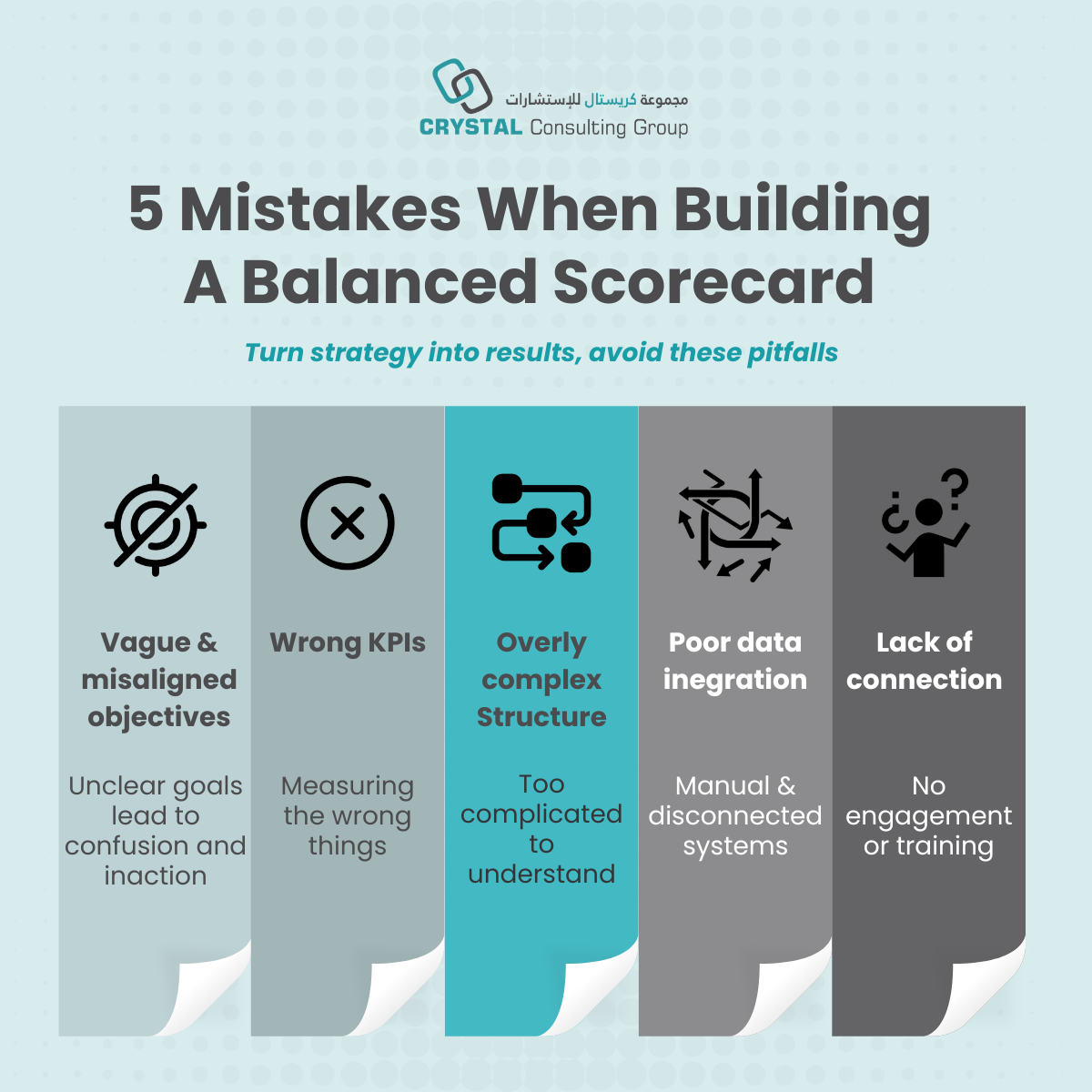
Main Takeaways

Building an effective balanced scorecard requires avoiding these critical mistakes that derail strategic execution:

  • Strategic Misalignment: Vague objectives and poorly chosen KPIs confuse teams rather than providing clarity, leaving everyone uncertain about priorities and success measures
  • Complexity Overload: Overly complicated structures overwhelm users, reducing adoption and practical utility across your organization
  • Stakeholder Disconnection: Poor communication isolates scorecards from operational reality, making them irrelevant to daily decisions
  • Data Integration Gaps: Manual processes and disconnected systems limit real-time strategic visibility and actionable insights

Mistake #1: Creating Vague or Misaligned Objectives

Strategic objectives form the backbone of every successful balanced scorecard, yet many organizations sabotage their efforts by creating objectives that sound impressive but fail to provide actionable direction. When objectives lack precision and strategic connection, even the most well-intentioned scorecard becomes an exercise in futility rather than a driver of organizational success.

Your teams can’t execute what they don’t understand. Organizations frequently stumble at the very foundation by crafting objectives like “improve customer satisfaction” or “enhance operational efficiency” without defining what improvement actually means. These broad statements fail to establish clear success criteria or explain how you’ll measure achievement. Without specific, actionable objectives, your teams won’t understand their role in strategic execution, and you’ll lack the criteria needed to make informed resource allocation decisions.

Even more damaging is disconnecting your scorecard objectives from your overall strategic plan. When scorecard objectives exist in isolation rather than flowing directly from strategic planning, they become disconnected activities that consume resources without advancing strategic goals. This misalignment ensures that even well-intentioned efforts fail to contribute meaningfully to organizational success.

Missing cause-and-effect relationships between perspectives compounds these issues further. Without clear linkages showing how learning initiatives drive process improvements, which enhance customer value, which ultimately delivers financial results, you end up with fragmented metrics rather than a cohesive strategic framework. Successful strategy formulation defines what your organization aims to achieve and how you’ll compete, creating the foundation for interconnected scorecard objectives.

The solution requires establishing focused, interconnected objectives that create a clear line of sight from operational activities to strategic outcomes. Only through this precision can you move beyond measurement activity to meaningful strategic execution that drives sustainable competitive advantage.

Mistake #2: Choosing the Wrong Key Performance Indicators (KPIs)

Even the most thoughtfully crafted strategic objectives become meaningless when you pair them with the wrong metrics. You’ll consistently undermine your strategic execution by selecting KPIs based on convenience rather than strategic relevance, creating elaborate measurement systems that track everything except what truly matters.

The most damaging error happens when you choose metrics that measure activity rather than achievement. Your customer service department might diligently track call volume and response time while completely ignoring customer satisfaction or retention rates. These activity-based measures create the illusion of performance management while missing the fundamental question: are you actually delivering exceptional customer experiences? When your metrics don’t connect to objective achievement, scorecards become elaborate reporting exercises that consume resources without driving strategic progress.

You’ll compound this problem by overwhelming your scorecards with excessive measures. The instinct to track everything stems from believing that comprehensive coverage equals better management, but this approach dilutes focus from the vital few metrics that truly matter. When your users face dozens of measures across multiple perspectives, they struggle to identify priorities and often abandon the scorecard entirely.

The imbalance between lagging and leading indicators creates another critical blind spot. According to McKinsey & Company, leading indicators provide early warning signals and guidance for course correction, while lagging indicators confirm whether strategies deliver the expected results. Without this balance, you either lack predictive insight or fail to confirm actual outcomes.

Successful metric selection requires disciplined focus on measures that directly connect to your strategic objectives, balancing comprehensive insight with actionable clarity. Using a structured KPI development process ensures your metrics drive decision-making rather than drowning it in data. With the right KPIs in place, you’ll face the next challenge: structuring these metrics in ways that enhance rather than complicate strategic understanding.

Mistake #3: Building an Overly Complex Balanced Scorecard Structure

Your strategic dashboard becomes a liability when stakeholders need a roadmap to understand it. Complex scorecards transform what should be clear decision-making tools into overwhelming puzzles that teams actively avoid. This happens more often than most leaders realize—the natural instinct to capture every metric creates comprehensive frameworks that obscure rather than illuminate strategic insights.

Complexity creeps in when teams believe more detail equals better strategic management. Organizations pack scorecards with excessive perspectives beyond the classic four, create multi-layered frameworks with dozens of objectives, and build hierarchies requiring training manuals to interpret. This structural overload undermines the scorecard’s fundamental purpose: aligning your organization around clear strategic priorities.

You’ll see this damage most clearly in stakeholder engagement. When executives can’t quickly grasp performance trends or middle managers struggle to connect their department’s work to broader goals, your scorecard loses its power to drive coordinated action. The tool meant to create strategic focus instead creates confusion.

Effective balanced scorecards embrace strategic focus over exhaustive coverage. Successful organizations typically stick to the traditional four perspectives unless compelling business needs demand additional viewpoints. Within each perspective, they concentrate on three to five key objectives that directly support strategic priorities, with each objective connecting to carefully selected measures that provide clear performance insights.

The most powerful scorecards tell coherent strategic stories rather than attempting comprehensive organizational measurement. Strategy maps demonstrate this principle by visualizing organizational strategy on a single page, showing how each strategic objective connects to create a narrative every employee can understand. This focused approach creates tools stakeholders actually embrace, setting the foundation for robust strategic planning tools and data integration capabilities that transform strategic measurement from administrative burden into competitive advantage.

Mistake #4: Failing to Secure Balanced Scorecard Data Integration

Your balanced scorecard becomes an expensive burden when teams spend hours each month manually collecting performance data. Organizations that rely on disconnected spreadsheets and chase updates across departments create systems so error-prone and sluggish that strategic decision-making becomes nearly impossible. Instead of enabling swift strategic responses, these manual processes transform what should be strategic assets into administrative nightmares.

Data silos kill balanced scorecard effectiveness by fragmenting your performance picture. Financial metrics live in one system while customer satisfaction scores exist on another platform, and operational data sits trapped in yet another database. This fragmentation prevents you from seeing the interconnected relationships that make scorecards powerful. Executives make strategic decisions based on incomplete information while middle managers struggle to understand how their performance connects to organizational goals.

Performance management software eliminates this burden by automating your entire data collection process. Instead of wrestling with manual spreadsheets, these systems connect seamlessly with your existing business applications—including CRM platforms, financial systems, project management tools, and HR databases—to import performance data automatically on predetermined schedules. You get consistently current metrics without the maintenance headache.

Missing automated alerts and drill-down capabilities means problems go unnoticed until quarterly reviews reveal them too late. Teams miss critical opportunities for timely intervention when they can’t spot performance issues as they develop. This delay transforms manageable challenges into major organizational crises that could have been prevented with earlier detection.

The benefits extend far beyond efficiency gains. Research shows that integrations improve overall efficiency by establishing a single source of truth for data across different systems, streamlining management processes and enhancing decision-making consistency. When automation handles routine data collection, your team shifts from gathering information to analyzing it and implementing strategic improvements.

Modern data integration platforms allow you to schedule automated data imports from various sources including SaaS tools, spreadsheets, databases, and web applications. You can also trigger imports based on specific events, ensuring your metrics stay current without manual intervention. With proper integration, your balanced scorecard evolves from a static reporting tool into a living strategic guide that influences daily decisions.

Beyond technical implementation lies your next challenge: ensuring your organization actually embraces and uses the scorecard you’ve built.

Mistake #5: Neglecting Communication and Change Management

Even perfectly designed balanced scorecards become expensive shelf decorations without organizational buy-in. Organizations that treat scorecard implementation as purely a technical project miss the fundamental truth: sustainable performance management requires cultural transformation, not just new dashboards.

Your communication challenge extends far beyond system announcements. Teams need to understand why these specific metrics drive organizational success and how measurements connect to their daily decisions. Without this foundation, stakeholders view the scorecard as another reporting burden rather than a strategic tool. When people can’t interpret performance data or don’t know how to respond to insights, sophisticated dashboards become nothing more than colorful charts in monthly meetings.

Moving from intuition-based decisions to evidence-based actions represents a fundamental cultural shift that many organizations underestimate. This transformation requires more than new software—it demands changing how people think about performance and accountability. Teams accustomed to traditional approaches often resist data-driven methodologies, especially when they feel unprepared to succeed in this new environment.

Sustainable adoption requires comprehensive training that goes beyond basic system navigation. Stakeholders need to understand scorecard interpretation, recognize performance patterns, and know how to take appropriate action based on what they see. This means role-specific training programs, ongoing support resources, and regular check-ins to address challenges as they arise.

When you invest in change management with the same intensity you apply to technical design, balanced scorecards become powerful catalysts for strategic alignment and improved execution. Success requires team alignment where everyone understands not just what to measure, but why these measurements matter and how to act on the insights they provide. With proper change management, your scorecard transforms from a monitoring tool into a driver of organizational performance and strategic clarity.

Transform Your Strategic Execution with Spider Impact

You don’t have to struggle with the common balanced scorecard pitfalls we’ve discussed. Spider Impact transforms these challenges into streamlined solutions through intuitive strategy mapping, automated data integration, and comprehensive KPI tracking capabilities. The platform eliminates disconnected spreadsheets and manual processes that create most implementation headaches.

Spider Impact gives you the foundation for strategic clarity and organizational alignment. Your balanced scorecard becomes a performance driver rather than just another reporting burden. User-friendly dashboards engage stakeholders naturally, while automated systems ensure data accuracy and real-time visibility.

Ready to see how Spider Impact can transform your strategic execution? Schedule a demo today.