Introduction
Your leadership team spent weeks perfecting a strategic plan, but six months later, ambitious goals remain trapped on paper while teams struggle to connect daily work with strategic priorities.
This execution gap plagues organizations everywhere. Most leaders excel at strategy development but struggle to bridge the distance between boardroom vision and frontline reality. The missing piece isn’t better planning–it’s the measurement framework that transforms abstract concepts into actionable targets.
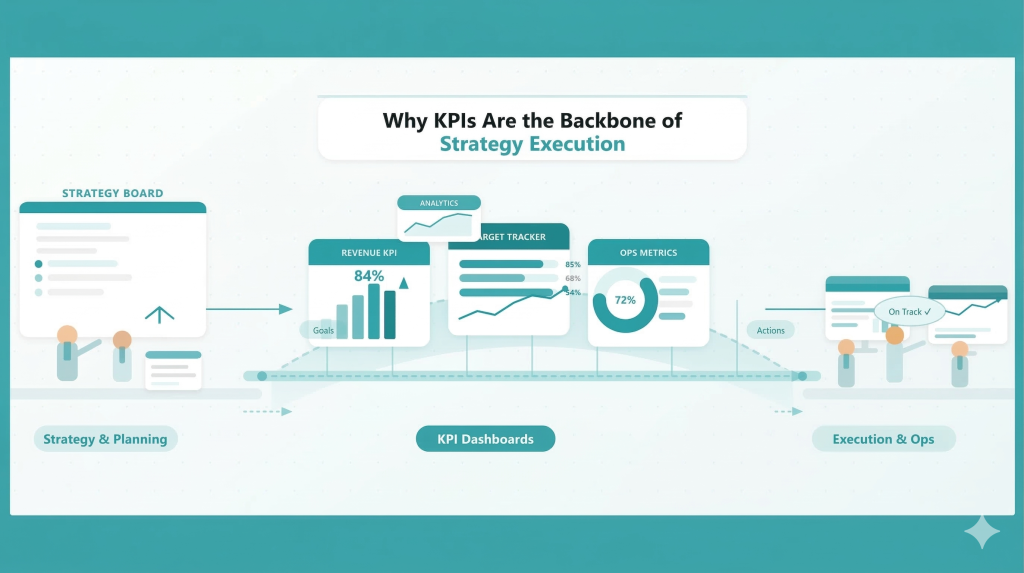
Key Performance Indicators serve as this critical bridge, converting strategic aspirations into concrete metrics that guide decisions at every level. When you implement KPIs effectively, they create the clarity and accountability needed to turn wishful thinking into predictable results. Your strategy execution shifts from hoping for success to systematically achieving it.
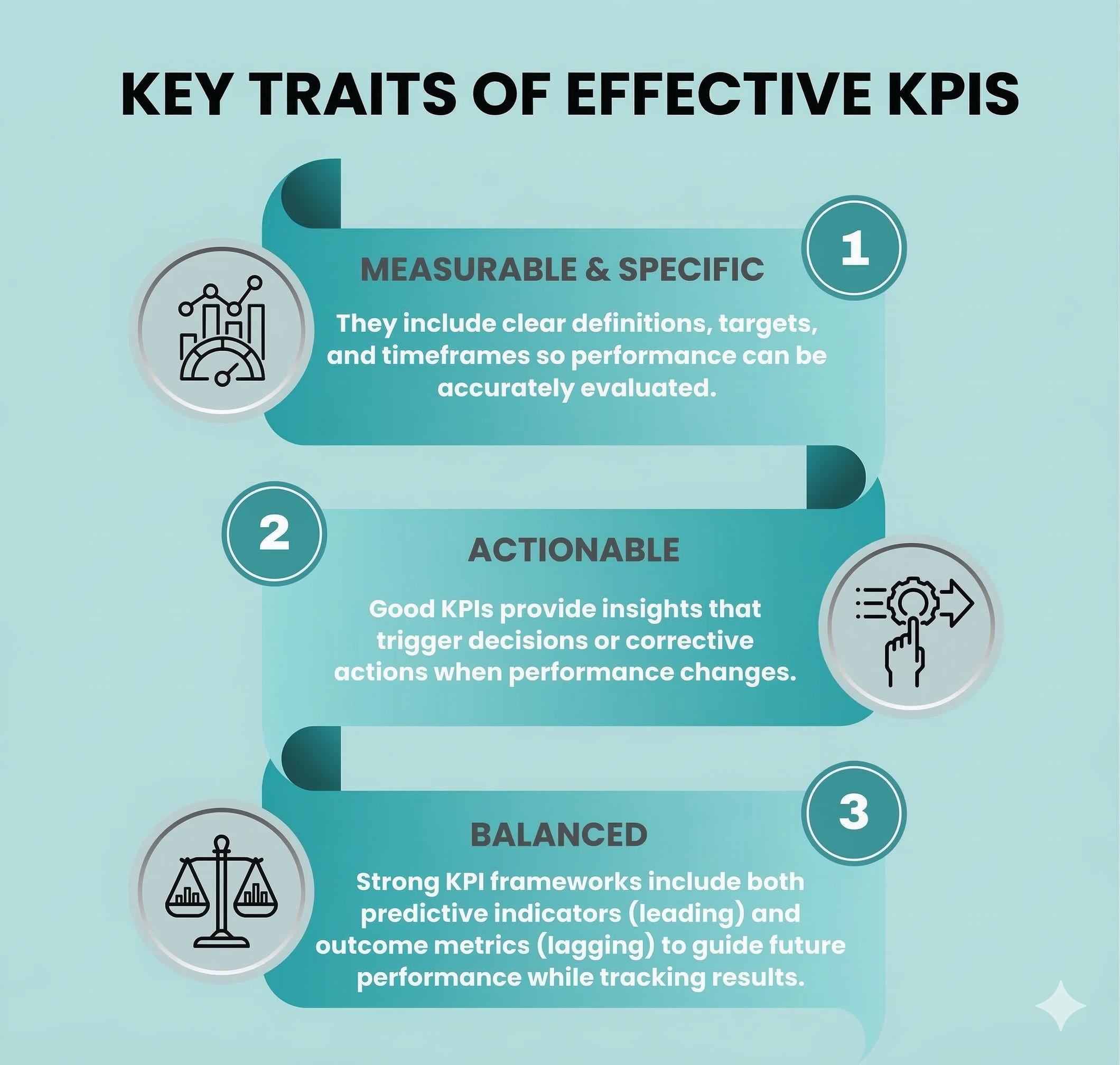
Three core characteristics separate strategic KPIs from everyday measurements. First, they connect directly to specific strategic objectives rather than departmental activities. Second, they influence management decisions rather than simply reporting results. Third, they predict future outcomes rather than documenting past performance. Organizations drowning in data often mistake activity measurement for strategic insight, missing the critical distinction between busy work and meaningful progress.
The most powerful strategic KPIs create perfect alignment between individual efforts and organizational vision. Strategic planning helps organizations define business goals and creates a strategy map for achieving them, making this connection essential for success. When your customer service representative understands how their satisfaction scores connect to market share growth, or when your product developer sees how feature adoption rates drive revenue targets, strategic alignment transforms abstract corporate goals into personal accountability. This connection eliminates the common scenario where departments optimize their metrics while the organization struggles to achieve its broader objectives.
Strategic measurement demands careful balance between two complementary indicator types. Leading indicators predict future performance by measuring activities that drive results–pipeline quality, employee engagement levels, or innovation investment. Lagging indicators confirm whether strategies succeeded by tracking outcomes like revenue growth, market share, or customer retention. Organizations relying solely on lagging indicators react to problems after damage occurs, while those using only leading indicators may optimize activities that don’t translate into meaningful results.
Every strategic indicator must pass the actionability test to earn its place in executive dashboards. When monthly customer acquisition costs increase beyond acceptable levels, this should trigger immediate investigation into marketing efficiency, sales process effectiveness, or market competition–not simply document the problem. Impressive-looking statistics that don’t trigger specific management responses remain expensive decorations rather than strategic tools.
Strategic KPIs must also meet rigorous specificity standards to drive accountability and urgency. Transforming vague objectives like “improve customer satisfaction” into precise measurements such as “increase Net Promoter Score from 7.2 to 8.5 within 12 months” creates the clarity your teams need to focus their efforts effectively. The e-commerce market demonstrates this principle in action, where revenue reached 1.18 trillion U.S. dollars in 2024 following consistent growth patterns. Performance management allows employees to see how their individual goals align with company goals and understand how they contribute to achieving those, encouraging engagement. Organizations building winning market strategies with trusted insights understand that specificity transforms abstract objectives into measurable outcomes.
When strategic KPIs combine these characteristics–directional guidance, strategic alignment, balanced timing, actionable insights, and precise definition–they accelerate execution rather than simply documenting it.
How KPIs Transform Organizational Performance
Picture two companies with identical strategies–one consistently hits its targets while the other struggles despite having talented teams and solid resources. The difference rarely lies in their planning quality. It comes down to their ability to translate strategic vision into coordinated daily action across every level of the organization.
Strategic KPIs create organizational unity by establishing shared accountability. When departments chase conflicting interpretations of success, chaos follows. Marketing celebrates lead generation while sales struggles with conversion rates. Operations optimizes for efficiency while customer service prioritizes satisfaction at any cost. Well-designed KPIs eliminate this confusion by ensuring every team member understands how their performance directly contributes to overarching strategic goals. Teams shift from territorial competition to genuine collaboration.
Measurement systems dissolve the departmental silos that plague many organizations. Customer acquisition costs from marketing connect directly to lifetime value metrics in customer success, prompting teams to work together rather than in isolation. Operational efficiency measures align with revenue growth targets, transforming competing departments into an integrated system. KPIs make interdependence visible and valuable, shifting organizational culture from protecting individual territories to pursuing collective achievement.
The most profound transformation occurs when KPIs replace gut-feeling decisions with data-driven strategic choices. Leaders gain an objective foundation for strategic discussions, turning boardroom debates from opinion-based arguments into evidence-based problem-solving sessions. Resource allocation, priority setting, and course corrections become grounded in performance evidence rather than incomplete information or instinct.
Data-driven organizations respond rapidly to changing conditions through real-time KPI monitoring. They detect performance gaps, market shifts, and operational issues while there’s still time to respond effectively. Organizations that master this capability gain competitive advantages through their ability to adapt quickly and decisively, rather than waiting for quarterly reviews to identify problems after damage has already occurred. The shift toward more agile, intelligent ways of doing business has accelerated across industries as organizations seek to remain competitive in rapidly evolving markets.
This transformation power creates a solid foundation, but even the most thoughtful KPI implementations can derail if you don’t avoid common mistakes that sabotage strategic execution.
Avoiding Critical KPI Mistakes
Well-intentioned measurement systems often backfire spectacularly. Organizations discover their carefully designed metrics created perverse incentives, distracted teams from meaningful work, or generated impressive dashboards that revealed nothing about actual performance.
The most common trap involves tracking everything instead of focusing on what matters. Organizations fall into measurement overload, believing comprehensive tracking equals comprehensive insight. This creates environments where teams spend more time collecting data than using it for strategic decisions. When you review dashboards containing dozens of metrics, you can’t identify which indicators actually demand attention. Operational metrics provide real-time insight into process performance, but tracking 5-7 key metrics per critical process ensures actionable insights without overwhelming teams. The fundamental problem lies in confusing activity with achievement–teams become busy maintaining measurement systems rather than driving strategic progress.
Vanity metrics represent another critical pitfall that sabotages strategic execution. These measurements look impressive in presentations but fail to connect to meaningful business outcomes. Marketing decision-makers worldwide commonly track various KPIs to measure performance, yet many organizations prioritize metrics that don’t drive real business value. While social media analytics remain the top KPI for measuring content success, with 57% of B2B companies and 63% of B2C companies tracking shares, followers, and views, these numbers often fail to translate to business results. Website traffic, social media followers, or total revenue without context create false confidence while masking underlying performance issues. Teams celebrate growing vanity metrics even as customer satisfaction declines or market share erodes.
Gaming behaviors create the most damaging consequences when teams optimize KPIs at the expense of actual performance. Customer service representatives rush through calls to meet volume targets while destroying customer experience. Sales teams prioritize quick wins over relationship building to hit monthly numbers. These behaviors emerge when KPIs become ends in themselves rather than means to strategic success. You need measurement systems that capture complete performance pictures rather than just the easiest elements to quantify.
Recognizing these pitfalls helps you implement KPIs that genuinely accelerate strategic execution rather than creating impressive-looking distractions from real performance.
Turning Strategy Into Reality
The gap between ambitious strategic plans and actual results haunts organizations across every industry, creating one of leadership’s most costly challenges. Research reveals that 60% to 90% of well-crafted strategies fail due to poor implementation, while 90% of organizations fail to successfully execute their strategies according to Harvard professor Robert Kaplan.
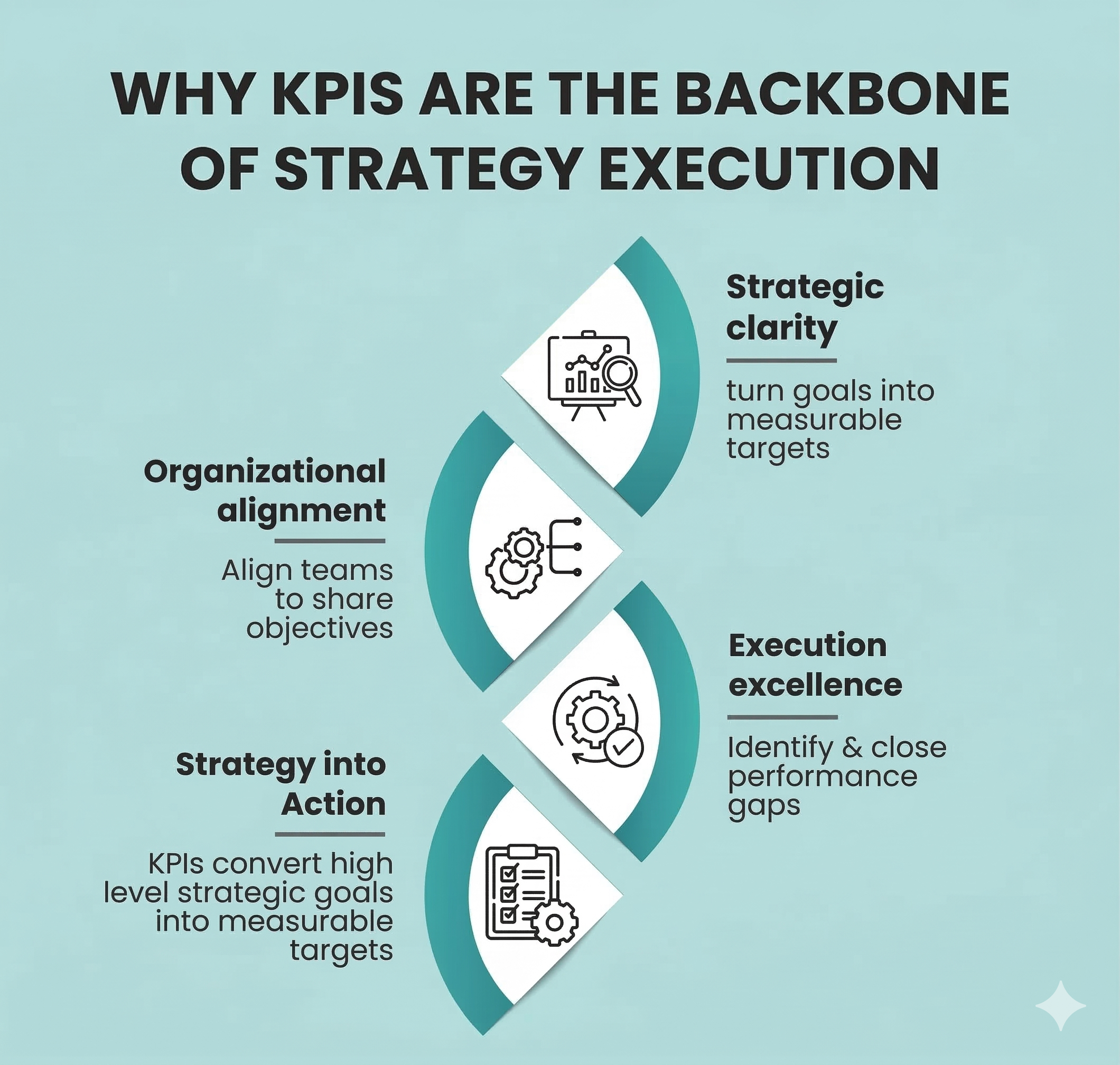
KPIs serve as the essential bridge between strategic vision and operational reality. They transform abstract concepts into specific, measurable targets that teams can understand, pursue, and achieve. Organizations that master this translation process gain decisive competitive advantages through faster execution, quicker market adaptation, and consistent progress toward their most important objectives.
The urgency becomes clear when you consider today’s market landscape. The global software market alone shows projected revenue for the United States estimated at US$395.00bn in 2026, highlighting massive opportunities available to organizations with effective strategy execution–and substantial losses awaiting those with poor implementation.
Effective KPIs create organizational alignment by connecting individual work directly to company goals. Department leaders make confident resource decisions based on clear performance indicators. Senior executives gain the visibility needed to spot emerging challenges before they threaten strategic progress. This measurement-driven approach transforms strategy execution from hopeful activity into systematic achievement.
The transformation creates organizational cultures where strategic success becomes everyone’s responsibility rather than just leadership’s aspiration. Teams develop shared accountability around measurable outcomes, building the collective commitment necessary to turn strategic vision into tangible results that drive sustainable competitive advantage.
Platforms like Spider Impact make bridging the execution gap practical and scalable. By translating strategic goals into clear, measurable KPIs, Spider Impact enables real-time tracking, cross-departmental alignment, and actionable insights at every organizational level. With dashboards that visualize progress, automated alerts for deviations, and tools to cascade objectives from executives to frontline teams, Spider Impact turns abstract strategy into operational reality—ensuring that your organization not only sets ambitious goals but consistently achieves them.
Conclusion
Strategic KPIs transform ambitious plans into measurable achievements by creating clear pathways from vision to execution. They eliminate the disconnect between planning and performance, ensuring every organizational effort contributes meaningfully to your strategic success.
When you implement strategic KPIs effectively, you build an organization that adapts quickly to market changes while maintaining unwavering focus on critical objectives. These measurement frameworks become the foundation for sustainable competitive advantage through consistent, data-driven execution.
The question isn’t whether your organization needs strategic KPIs–it’s whether you’re ready to unlock the execution power they provide.